How to reduce sugar level, and keep it down
Blood sugar comes down when four things work together: medicine taken as prescribed, muscles that are used every day, sensible meals and enough sleep. Of these, movement is the one most families under-use. A 10 to 15 minute walk after each meal and three short strength sessions a week lower sugar in a way that shows up on the glucometer within days.
By the Omfit coaching team · Updated 12 September 2026 · 10 min read
If you have just seen a high reading and want it down quickly, here is the honest answer. Take your medicine exactly as prescribed. Never skip a dose or take a double dose to "fix" a number without talking to your doctor. Drink water, and go for a slow 15 minute walk if you feel well. Then check again in two hours. One high reading is information, not an emergency, unless it comes with the warning signs listed further down.
Keeping sugar down over months is a different problem, and it is mostly about muscle. Muscle is where the body stores glucose after a meal. When muscles are used, they pull sugar out of the blood on their own, without needing insulin to open the door. This is why people with diabetes are told to walk after meals, and why strength training matters more after 55, when muscle is naturally shrinking. This page gives you the walking plan, the exercises, and the safety rules.
Why movement lowers blood sugar1 min read
- Working muscles absorb glucose directly from the blood, during the activity and for several hours afterwards. This works even when the body has become resistant to insulin.
- A 10 to 15 minute walk started within 30 minutes of a meal cuts the after-meal spike, which is the reading that does the most damage over time.
- Strength training builds more muscle, which means a bigger store for glucose to go into after every meal, not just on exercise days.
- Regular activity improves sleep and lowers stress hormones, both of which push sugar up when they are out of balance.
The exercises3 min read
Exercise 1
Post-meal walk

The single most effective habit for after-meal sugar. Uses the biggest muscles in the body right when glucose is entering the blood.
- Finish eating, wait no more than 20 to 30 minutes, then start walking.
- Walk at an easy pace inside the house, on the terrace or in the lane. You should be able to talk normally.
- Keep going for 10 to 15 minutes, then sit and rest.
How much: 10–15 minutes after breakfast, lunch and dinner
Easier version: Walk for 5 minutes after each meal and add 2 minutes every week.
Stop if: Walk on level ground in proper shoes. If you feel dizzy, shaky or sweaty, stop and sit down. Check your sugar if you can; take sugar if it is low (below 70 mg/dL) or if you cannot check. Do not walk outdoors alone after dinner if lighting is poor.
Exercise 2
Sit-to-stand
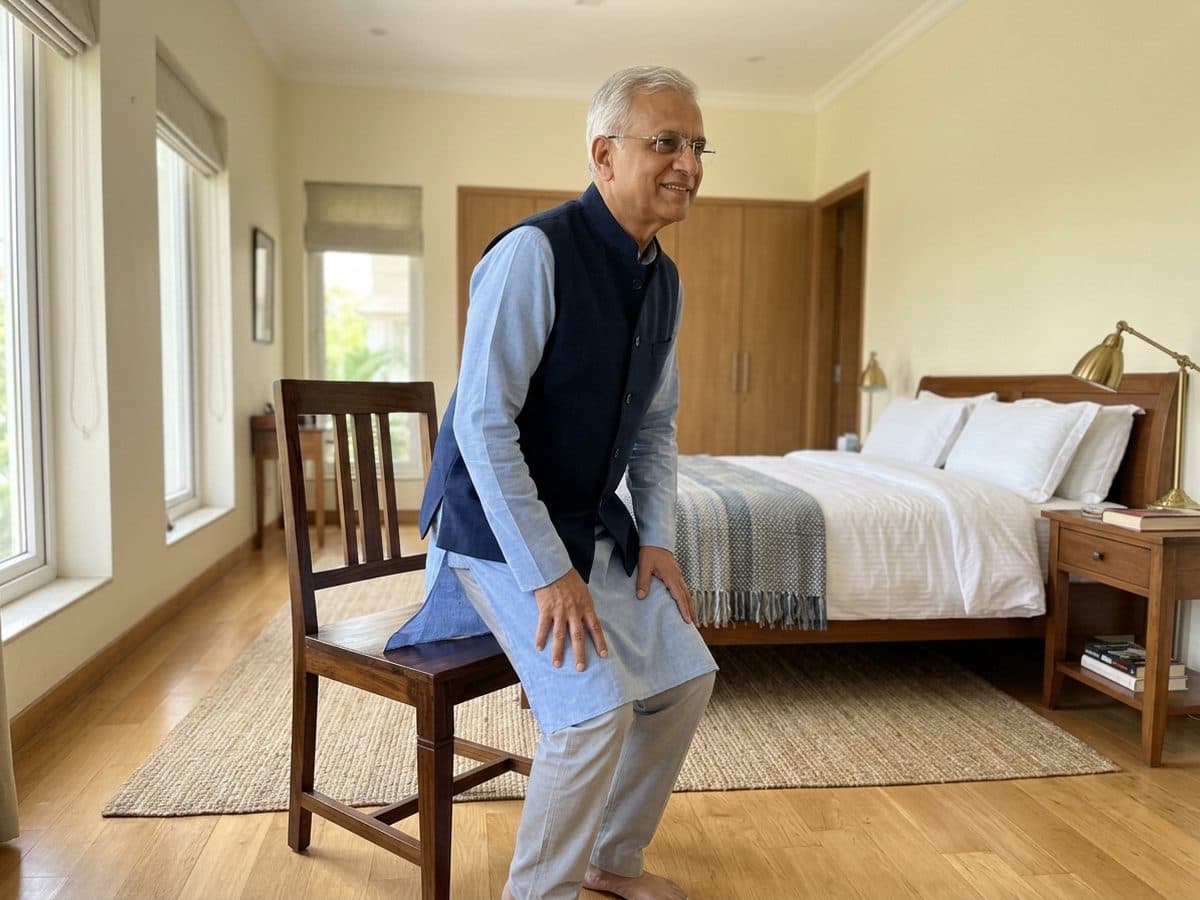
Thighs and hips are the largest muscles you own. Working them stores the most glucose.
- Sit on the front half of a firm chair with feet flat and slightly behind the knees.
- Lean forward and stand up, pushing through the heels. Use your hands on your thighs if needed.
- Sit back down slowly over 3 seconds, then repeat.
How much: 8–10 repetitions, 2 rounds
Easier version: Use a higher chair or add a cushion so you do not have to sit as low.
Stop if: Keep breathing normally throughout. Stop if you feel knee pain or become breathless.
Exercise 3
Wall push-ups

Works chest, shoulders and arms safely, adding upper-body muscle to the glucose store.
- Stand an arm's length from a wall, palms flat on the wall at shoulder height.
- Bend the elbows and bring your chest towards the wall, keeping the body straight.
- Push back to the start slowly.
How much: 10 repetitions, 2 rounds
Easier version: Stand closer to the wall so there is less body weight to push.
Stop if: Keep the feet flat and do not hold your breath. Stop if you feel pain in the wrists or shoulders.
Exercise 4
Seated march

A gentle way to get the legs moving on days when walking is not possible, such as in bad weather or after a poor night.
- Sit tall on a chair, hands lightly on the seat or thighs.
- Lift one knee a few inches, lower it, then lift the other.
- Continue at a steady rhythm, like slow walking.
How much: 2 minutes, rest, repeat 2–3 times
Stop if: Sit back in the chair so you cannot slip forward. Slow down if you feel light-headed.
Exercise 5
Seated calf raise (the soleus push-up)

The deep calf muscle burns blood sugar for fuel even when used lightly, and it can be worked for a long time while sitting. Useful during TV or phone time.
- Sit with feet flat on the floor, knees at a right angle.
- Keeping the toes on the floor, lift both heels as high as you can.
- Lower them and repeat at a relaxed, steady pace.
How much: 3–5 minutes at a time, several times a day
Stop if: Stop if the calves cramp. If you have numb feet, check them afterwards for any rubbing or redness.
Exercise 6
Towel row or band row
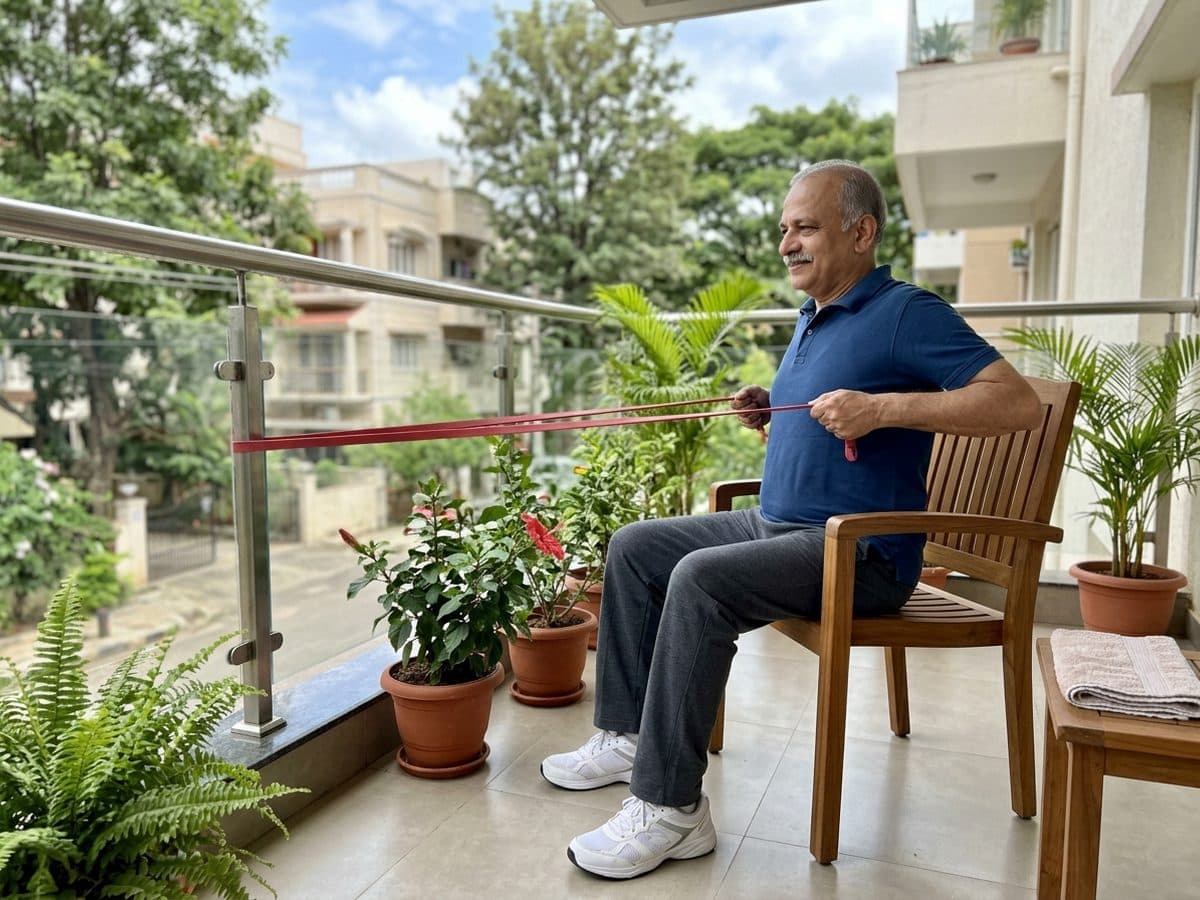
Strengthens the back and arms, which most parents never train, and balances the wall push-up.
- Loop a towel or resistance band around a sturdy door handle or pillar, and hold one end in each hand.
- Sit or stand with arms straight, then pull the elbows back past your body, squeezing the shoulder blades together.
- Return slowly to the start.
How much: 10 repetitions, 2 rounds
Stop if: Check the door or pillar cannot move. Keep the shoulders down, away from the ears, and breathe out as you pull.
Exercise 7
Step-ups

The stair step at home is a ready-made leg exercise that raises the heart rate too.
- Stand in front of the bottom stair with a hand on the railing or wall.
- Step up with the right foot, then bring the left foot up beside it.
- Step back down, right foot first, and repeat, then lead with the left.
How much: 8 step-ups each leg, 2 rounds
Easier version: Use a low step, or simply tap the foot onto the step and back down without stepping up.
Stop if: Always hold the railing. Skip this if you have knee pain on stairs or any problem with balance, and do the seated march instead.
See a doctor before exercising if
- Sugar reading above 300 mg/dL, especially with vomiting, stomach pain, deep or fast breathing, or ketones in urine. Call the doctor before exercising.
- Sugar reading below 70 mg/dL, or feeling shaky, sweaty, confused or very hungry. Take sugar first, then rest. Do not exercise.
- Chest pain, tightness or pressure during or after activity.
- Sudden change in vision, or a severe headache.
- A wound, blister or redness on the feet that does not settle in a day. Numb feet can hide injuries, so look at them after every walk.
A daily plan that lowers sugar1 min read
You do not need a gym or an hour a day. The plan below fits around meals and takes about 45 minutes in total on strength days, and 30 to 45 minutes on the other days. Consistency matters more than any single session; the sugar-lowering effect of one walk fades within a day or two.
- Every day: 10 to 15 minute walk after breakfast, lunch and dinner.
- Every day: seated calf raises during any long sitting, 3 to 5 minutes at a time.
- Three days a week, with a rest day between: sit-to-stand, wall push-ups, towel row and step-ups (or seated march), 2 rounds each.
- Check sugar before and about two hours after a new exercise for the first week, and note it down. The numbers will tell you what works for your body.
- Show the log to your doctor at the next visit. Regular exercise sometimes means medicine doses need adjusting, and only the doctor should do that.
When not to exercise1 min read
Exercise is medicine, and like any medicine there are times to hold it. Sugar that is very high means the body is short of insulin, and hard exercise can push it higher, not lower. Sugar that is low will fall further with activity.
- Do not exercise if sugar is below 100 mg/dL and you take insulin or sulfonylurea tablets. Eat a small snack first and recheck after 15 minutes.
- Do not exercise if sugar is above 300 mg/dL, or above 250 mg/dL with ketones in urine. Take medicine as prescribed, drink water, and ask the doctor.
- Do not exercise when unwell with fever, vomiting or loose motions. Sugar is unpredictable during illness.
- If you feel a "low" coming on during exercise, stop, sit, and take 15 grams of sugar: 3 to 4 glucose tablets, half a cup of fruit juice or 3 teaspoons of sugar in water. Recheck after 15 minutes.
- Carry something sweet on every walk, and tell someone at home where you are going.
What about diet?1 min read
Food matters as much as movement, but a diet chart should come from your doctor or a registered dietitian who knows your medicines, kidney function and daily routine. This page will not replace that. Three plain rules hold for almost everyone and pair well with the exercise plan above.
- Eat vegetables and dal or protein first, rice or roti last. The order of the meal changes the spike.
- Keep the portion of rice, roti, bread and sweets steady from day to day. Big swings in carbohydrate make sugar hard to predict.
- Do not skip meals to bring a number down. It leads to lows, then overeating, then highs.
How Omfit members bring sugar down1 min read
Most parents with diabetes already walk. What they are missing is the strength work that builds the muscle glucose goes into, and someone to make sure it happens three times a week. Left to a YouTube video, the sit-to-stands get skipped and the wall push-ups are done with a held breath.
Omfit's live classes run three mornings or evenings a week with a certified coach watching a batch of nine on Zoom. Every member's health form is read before day one, so parents on insulin are reminded to check sugar before class and keep something sweet within reach. Coaches see who is breathless or shaky and drop them to the Level 1 version on the spot. On the days between classes, members get walking targets on WhatsApp, which turns the post-meal walk from advice into a habit.
Live classes for parents 55+
Get this done live, three times a week
Omfit's coaches run these progressions on Zoom for batches of nine parents. Health history reviewed before day one, every movement corrected as it happens, updates sent to the family.
12 live sessions · batch of 9 · 7-day refund · no auto-debit
Common questions1 min read
How can I reduce my sugar level immediately?+
Take your medicine on time, drink a glass of water, and take a gentle 15 minute walk if you feel well and the reading is below 300 mg/dL. Recheck after two hours. If the reading stays high, or you have vomiting, stomach pain or heavy breathing, call your doctor. Never take extra medicine on your own.
Does walking after meals really lower blood sugar?+
Yes. A 10 to 15 minute walk begun within about 30 minutes of a meal lowers the after-meal peak noticeably, because the leg muscles draw glucose straight from the blood. Three short walks a day work better than one long walk for this purpose.
Is strength training or walking better for sugar control?+
Both, and they do different jobs. Walking lowers sugar today. Strength training builds muscle so there is more room to store sugar every day, including days you do not exercise. Two or three short strength sessions a week alongside daily walking gives the best results in studies of older adults.
Can exercise replace my diabetes medicine?+
No. Exercise can reduce how much medicine some people need, but that decision belongs to your doctor, based on your readings and HbA1c. Keep a log of sugar readings and take it to your next appointment.
What sugar level is too high to exercise?+
As a general rule, do not exercise above 300 mg/dL, or above 250 mg/dL if you have ketones in the urine or feel unwell. Below 100 mg/dL, eat a small snack first if you are on insulin or sulfonylureas. Your own doctor may set different limits for you.