Knee pain exercises you can do at home, safely
The right exercises reduce knee pain by strengthening the muscles that hold the joint steady, not by working the joint harder. Below are eight chair-supported moves that most people over 55 can start today, with a gentler version of each.
By the Omfit coaching team · Updated 12 September 2026 · 7 min read
Knee pain after 50 is usually not a reason to stop moving. In most cases it is osteoarthritis, weak thigh muscles, or both, and the treatment your doctor or physiotherapist will suggest first is exercise. Resting the knee for weeks makes the muscles around it weaker, which makes the pain worse.
The catch is that the wrong exercise, or the right one done badly, aggravates the knee. Deep squats, running, and jumping load the joint surface, so leave them out early in rehab or when pain is high; many people work back up to them once the knee is stronger. The moves below load the muscles instead: the quadriceps, hamstrings, glutes and calves. Do them slowly, with a chair for support, and stop at mild discomfort rather than pushing through.
Why exercise reduces knee pain1 min read
- A strong quadriceps muscle takes load off the joint surface with every step. Weak thighs are the most common finding in painful knees.
- Movement pumps synovial fluid through the joint, which is why a stiff knee loosens after a short walk.
- Stronger hips and calves stop the knee from collapsing inward when you walk or climb stairs.
- Losing even 3–4 kg of body weight cuts the force through the knee several times over on stairs. Exercise makes that easier.
The exercises3 min read
Exercise 1
Seated knee extension

Strengthens the quadriceps without any body weight on the joint.
- Sit tall on a firm chair with both feet flat on the floor.
- Slowly straighten one leg until the knee is fully extended, toes pointing up.
- Hold for 3 seconds, then lower slowly over 3 seconds.
How much: 10 repetitions each leg, 2 rounds
Easier version: Straighten the leg only halfway and hold for 2 seconds.
Stop if: Stop if you feel sharp pain under the kneecap. Do not swing the leg up; slow control is the point.
Exercise 2
Heel slides
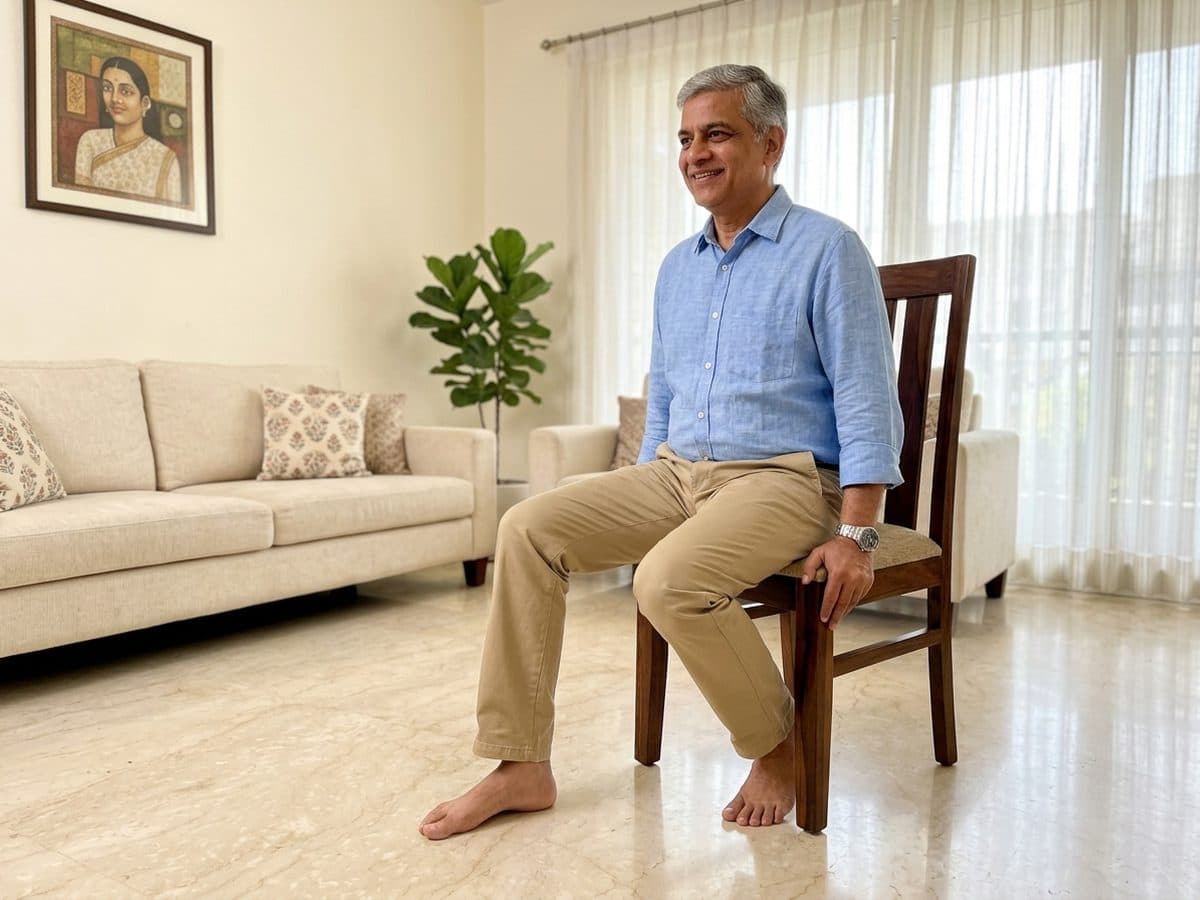
Restores bending range in a stiff knee without loading it.
- Sit on a chair or lie on your back with legs straight.
- Slide one heel towards your hip, bending the knee as far as is comfortable.
- Slide it back out slowly.
How much: 10 slides each leg
Stop if: Go only to the point of gentle stretch. If the knee catches or locks, stop and mention it to your doctor.
Exercise 3
Sit-to-stand

The single most useful strength exercise for daily life. Builds thighs and glutes in exactly the movement you use to get off a chair, a toilet or a car seat.
- Sit on the front half of a sturdy chair, feet hip-width apart and slightly behind your knees.
- Lean forward, push through your heels and stand up without using your hands if you can.
- Lower back down slowly over 3 seconds, touching the seat lightly before standing again.
How much: 8 repetitions, 2 rounds
Easier version: Use a higher chair or place cushions on the seat. Press lightly on your thighs to help.
Stop if: Keep the knees pointing in the same direction as the toes. If one knee dips inward, slow down or use your hands.
Exercise 4
Standing hamstring curl
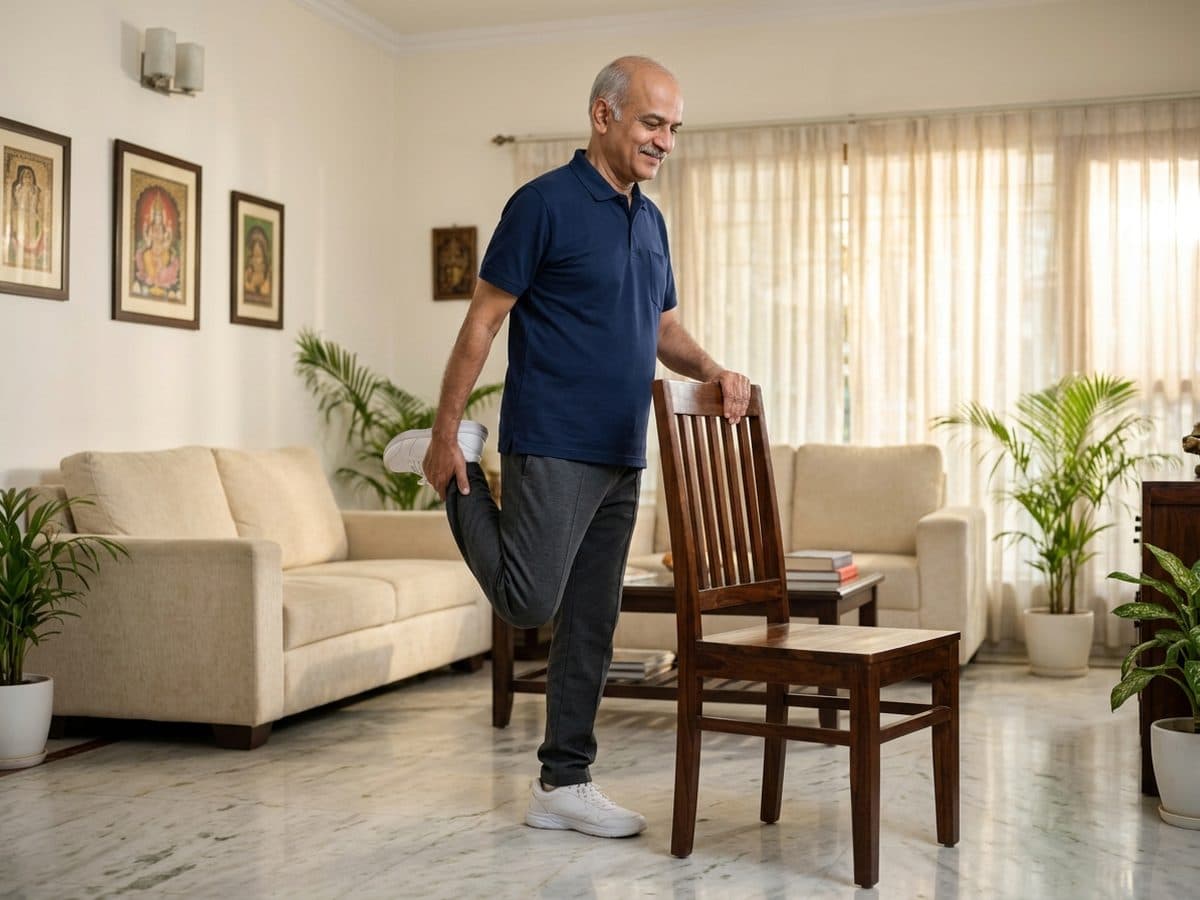
Balances the back of the thigh against the front, which steadies the knee.
- Stand behind a chair and hold the backrest.
- Bend one knee, bringing the heel towards your buttock.
- Hold for 2 seconds and lower slowly.
How much: 10 repetitions each leg
Stop if: Keep the knees side by side. Do not arch the lower back to lift the foot higher.
Exercise 5
Calf raises at the chair
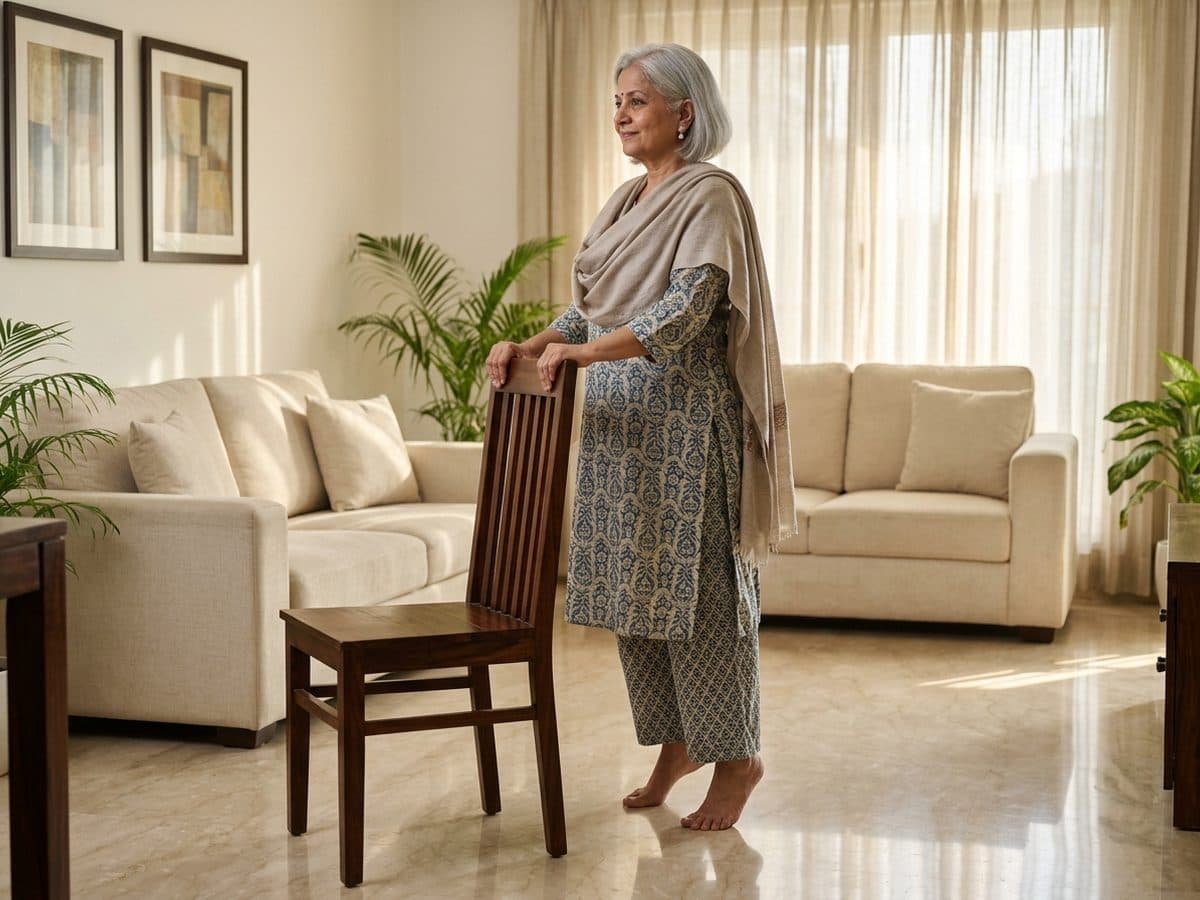
Strong calves absorb shock before it reaches the knee, and they protect balance.
- Stand holding the back of a chair, feet hip-width apart.
- Rise onto the balls of your feet as high as is comfortable.
- Lower over 3 seconds.
How much: 12 repetitions, 2 rounds
Easier version: Do it seated, lifting the heels while the toes stay on the floor.
Stop if: Stop if you feel cramping in the calf. Keep the weight over the big toe, not rolling to the outer foot.
Exercise 6
Side-lying or standing hip abduction
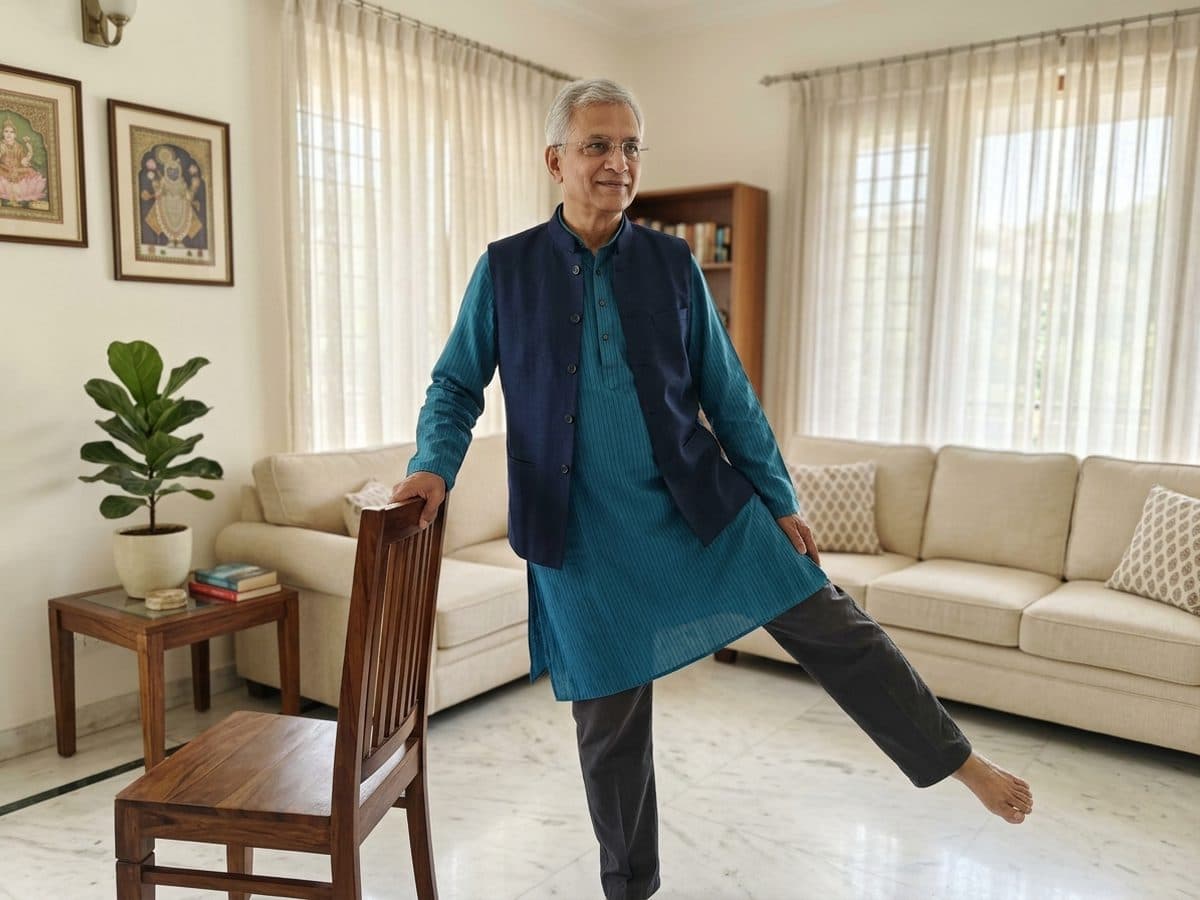
Weak outer hip muscles let the knee fall inward, a common hidden cause of knee pain.
- Stand holding a chair, or lie on your side with the lower knee bent.
- Lift the top leg out to the side, keeping the toes pointing forward and the body upright.
- Lower slowly.
How much: 10 repetitions each side
Stop if: Do not lean the trunk away to lift higher. A small, controlled lift is enough.
Exercise 7
Glute bridge
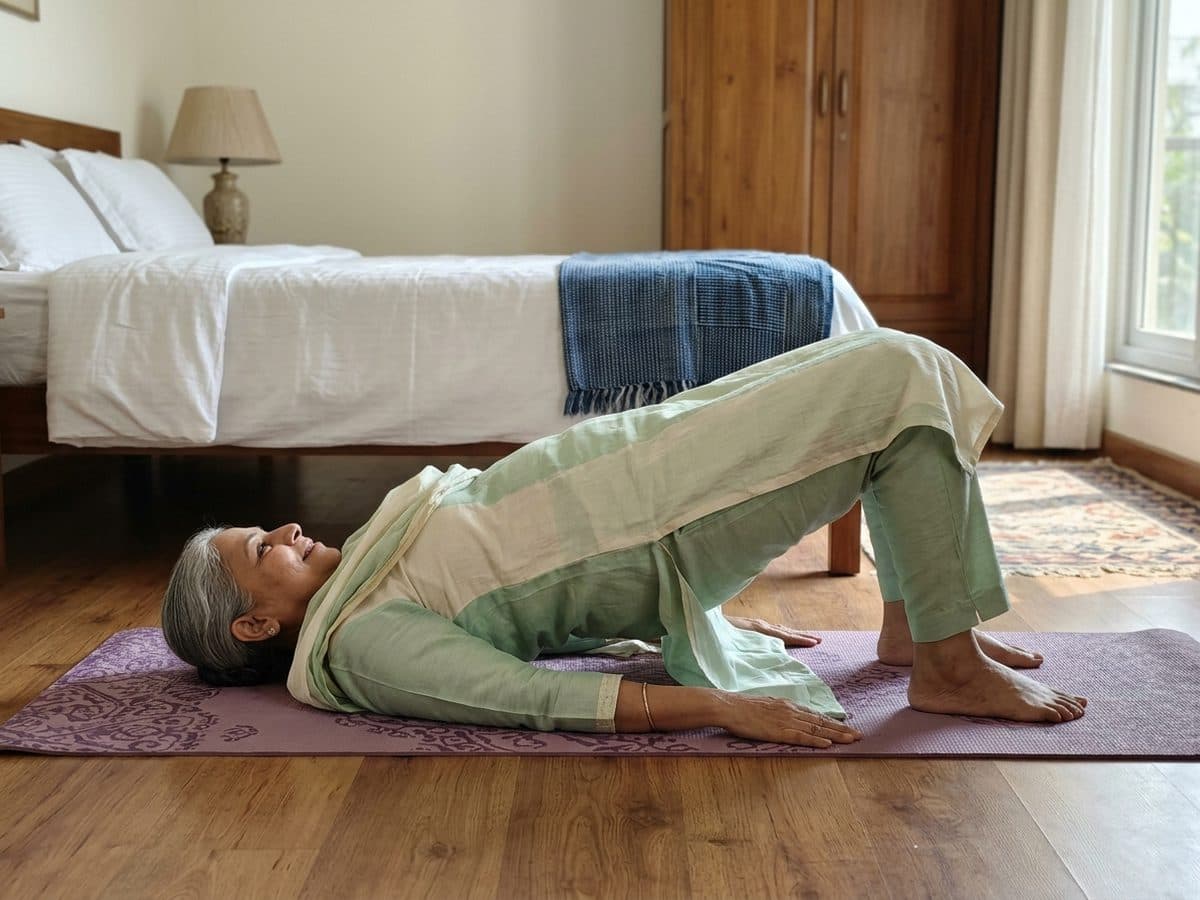
Strengthens the buttocks and hamstrings while the knee stays still.
- Lie on your back with knees bent, feet flat and hip-width apart.
- Squeeze the buttocks and lift the hips until the body forms a straight line from shoulders to knees.
- Hold 3 seconds, lower slowly.
How much: 10 repetitions
Easier version: Lift the hips only a few centimetres.
Stop if: Skip if you cannot get up and down from the floor comfortably. The sit-to-stand covers the same muscles.
Exercise 8
Quadriceps stretch, seated

Loosens a tight front thigh, which pulls on the kneecap.
- Sit sideways on a chair so one leg can hang off the edge.
- Slide that foot back under the chair until you feel a stretch in the front of the thigh.
- Hold 20–30 seconds, breathing normally.
How much: 2 holds each leg
Stop if: A gentle pull is fine. Never bounce.
See a doctor before exercising if
- The knee is warm, red or visibly swollen.
- The knee locks, gives way, or you cannot put weight on it.
- Pain started after a fall or twist.
- Pain wakes you at night or comes with fever.
- You have had knee surgery in the last 3 months and have not been cleared to exercise.
A 15-minute knee routine, three times a week1 min read
You do not need all eight exercises every day. A realistic routine for someone starting out is the one below. Rest a day between sessions; the muscles get stronger during recovery, not during the workout.
- Warm up: 3 minutes of marching on the spot or a slow walk around the house.
- Seated knee extension, heel slides, sit-to-stand: 2 rounds each.
- Hamstring curl, calf raise, hip abduction: 1 round each.
- Finish with the seated quadriceps stretch, both legs.
- After 3 weeks, add the second round to the standing exercises.
What to avoid with a painful knee1 min read
Some popular exercises are hard on a sore knee and offer nothing the moves above do not. Skip these until a physiotherapist clears you.
- Deep squats and full lunges: the load on the kneecap is several times body weight at the bottom.
- Sitting cross-legged or in a full squat for long periods.
- Running or jumping on hard floors.
- Straight-leg sit-ups that pull on the hip flexors and the knee.
- "Pushing through" sharp pain. Dull muscle effort is fine; sharp joint pain is a signal to stop.
Knee pain and walking1 min read
Walking is good for knees, but it is not enough on its own. Walking maintains fitness; it does not build the thigh strength that protects the joint. The best results in older adults come from combining a daily walk with strength work two or three times a week, which is exactly the combination the routine above gives you.
Doing these with a coach watching1 min read
Most knee flare-ups during home exercise come from one of three things: a knee dipping inward on a sit-to-stand, a leg swung instead of lifted on a knee extension, or too many repetitions too soon. All three are invisible to the person doing them and obvious to someone watching.
Omfit's live classes put a certified coach on a Zoom call with a batch of nine parents, three mornings or evenings a week. The coach sees every knee, corrects form as it happens, and gives the Level 1 version to anyone whose knee is sore that day. Members with knee replacements and arthritis are placed into the same progressions with modifications set before their first class, based on the health form the family fills in.
Live classes for parents 55+
Get this done live, three times a week
Omfit's coaches run these progressions on Zoom for batches of nine parents. Health history reviewed before day one, every movement corrected as it happens, updates sent to the family.
12 live sessions · batch of 9 · 7-day refund · no auto-debit
Common questions1 min read
Which exercise is best for knee pain?+
For most people over 55 the sit-to-stand is the single best exercise, because it strengthens the thigh and hip muscles in the movement you use dozens of times a day. Pair it with the seated knee extension if getting up from a chair is currently painful.
Can I exercise if I have knee arthritis?+
Yes. Exercise is the first-line treatment for knee osteoarthritis in every major guideline. Choose muscle-strengthening moves that keep the joint in a comfortable range, and avoid deep bending and impact. Expect mild soreness that settles within a day; pain that lasts longer means you did too much.
How long before knee pain improves with exercise?+
Most people notice stairs and getting up from a chair feel easier in 4 to 6 weeks of doing strength work two or three times a week. Pain reduction usually follows the strength gain rather than coming first.
Should I use a knee cap or brace while exercising?+
A soft knee sleeve is fine if it makes you feel more confident, but it does not replace strengthening. Ask your doctor before using a rigid brace, especially after surgery.
Is walking bad for knee pain?+
No. Regular walking on level ground is protective for knees. Reduce the distance on days the knee is sore rather than stopping altogether, and add the strength exercises above so the muscles carry more of the load.