Frozen shoulder exercises: eight gentle stretches to get your arm moving again
A frozen shoulder gets better slowly, and gentle daily stretching is the main thing that speeds it up. The eight exercises below loosen the tight capsule around the joint a little at a time. Done every day, most people regain enough movement to comb their hair, wear a saree or reach a top shelf again.
By the Omfit coaching team · Updated 12 September 2026 · 9 min read
Frozen shoulder, which doctors call adhesive capsulitis, is common between 40 and 65 and much more common in people with diabetes. The capsule around the shoulder joint becomes thick and tight, so the arm hurts and will not lift or turn the way it used to. It usually affects one shoulder, and simple things such as fastening a blouse hook at the back, reaching for a shelf or lying on that side become difficult.
It passes through three stages. In the freezing stage, pain is the main problem and movement gets steadily worse. In the frozen stage, the pain settles but the stiffness stays. In the thawing stage, movement slowly returns. The whole process can take a year or more, but gentle, regular stretching shortens it and keeps you able to use the arm. The rule for every exercise below is the same: go to the point of a firm stretch, never to sharp pain, and do a little every day rather than a lot once a week.
Why stretching helps a frozen shoulder1 min read
- The tight capsule is like a shirt that has shrunk. Frequent gentle stretching gives it back its length a few degrees at a time.
- Moving the arm daily stops the muscles around the shoulder from wasting while the joint is stiff.
- Warmth and movement improve blood flow, which eases the deep ache that comes with the freezing stage.
- Keeping the shoulder blade muscles strong means the arm moves well again once the capsule loosens, instead of the shoulder hunching up.
The exercises4 min read
Exercise 1
Pendulum swing

Lets gravity gently open the joint with no effort from the sore muscles. The best first exercise in the painful stage.
- Stand beside a table and rest the good hand on it, leaning forward slightly.
- Let the affected arm hang loosely towards the floor.
- Swing the body gently so the arm moves in small circles, then side to side.
How much: 1 minute in each direction, 2 or 3 times a day
Easier version: Do it seated, leaning forward with the arm hanging between the knees.
Stop if: The arm should hang relaxed. Do not lift it with the shoulder muscles or swing it hard.
Exercise 2
Towel stretch behind the back

Restores the reach-behind movement needed for blouse hooks, belts and washing the back.
- Hold a towel over the good shoulder, letting the other end hang down the back.
- Reach the affected hand behind the back and take hold of the lower end.
- Gently pull upward with the good hand so the affected arm slides up the back. Hold 15 seconds.
How much: 5 pulls, 2 rounds
Easier version: Simply hold the towel behind the back with both hands and let the affected arm rest there for 20 seconds.
Stop if: Pull gently and slowly. Stop at a firm stretch, before sharp pain.
Exercise 3
Finger walk up the wall

Builds the lift-forward movement a little higher each day.
- Stand facing a wall, about an arm's length away.
- Place the fingertips of the affected hand on the wall at waist height.
- Walk the fingers slowly up the wall as high as is comfortable, then walk them back down.
How much: 10 walks, 2 rounds
Easier version: Stand sideways to the wall and walk the fingers up out to the side, which is often less painful at first.
Stop if: Let the fingers do the work. Do not shrug the shoulder up to the ear or lean into the wall.
Exercise 4
Cross-body stretch

Loosens the back of the capsule, which restricts reaching across the body.
- Sit or stand tall.
- Use the good hand to lift the affected arm at the elbow and bring it across the chest.
- Hold a gentle stretch at the back of the shoulder for 20 seconds.
How much: 3 holds
Easier version: Rest the affected forearm on a table and slide it across the table top instead of lifting it.
Stop if: Keep the shoulder down and relaxed. Do not force the arm across.
Exercise 5
External rotation with a stick

Turning the arm outward is usually the most restricted movement, and the one that returns last without help.
- Sit or stand with both elbows bent to 90 degrees and tucked at the sides, holding a stick or rolling pin across the body.
- Use the good hand to push the stick so the affected forearm turns outward, elbow staying at the side.
- Hold 15 seconds, then return.
How much: 8 repetitions
Easier version: Lie on your back with the elbow at the side, and let the forearm fall outward with the stick, using gravity.
Stop if: The elbow must stay against the ribs. If it drifts away, you are cheating the stretch.
Exercise 6
Doorway chest stretch
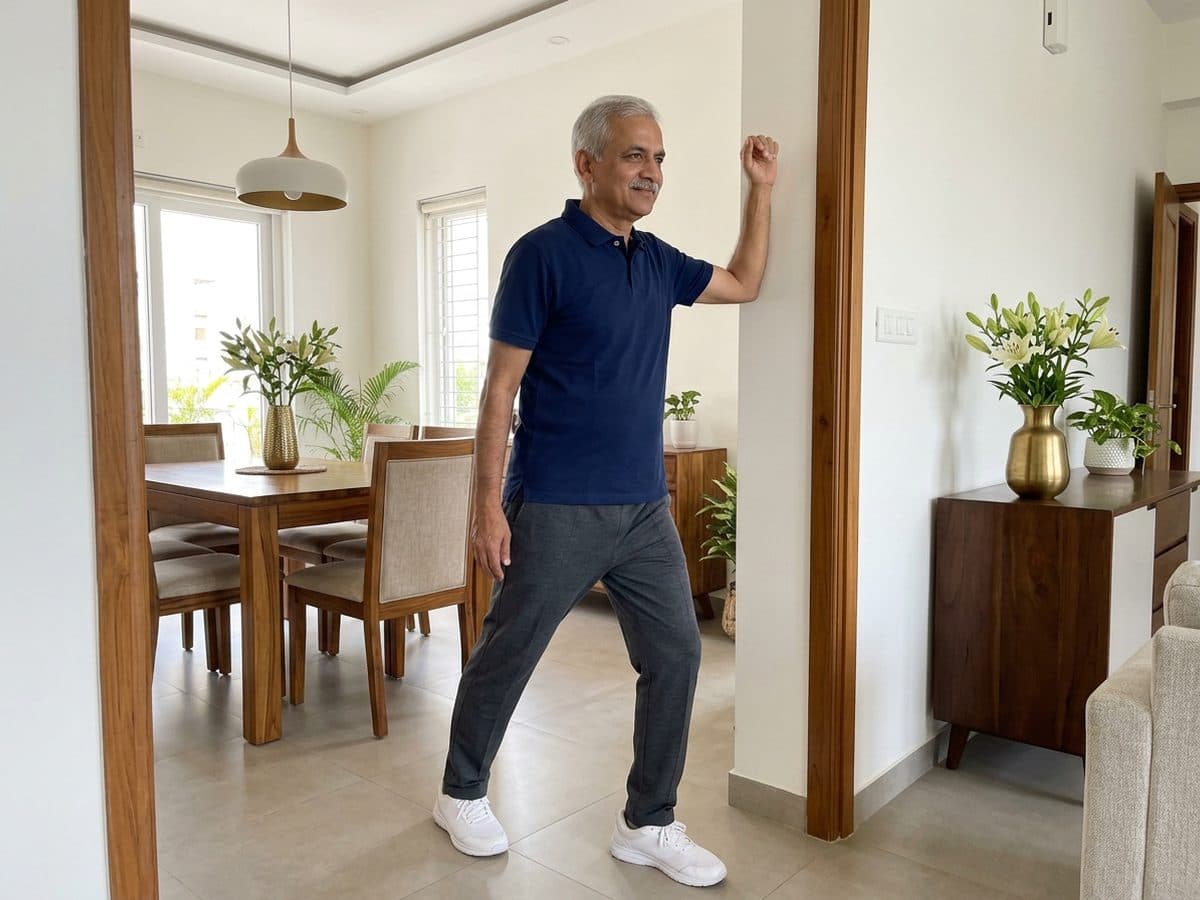
Opens the front of the chest and shoulder, which tightens when the arm has been held close to the body for weeks.
- Stand in a doorway and place the forearm of the affected side on the frame, elbow at about shoulder height or lower if needed.
- Step gently forward with the same-side foot until you feel a stretch across the chest.
- Hold 20 seconds, breathing normally.
How much: 3 holds
Easier version: Do the same stretch with the hand flat on a wall at waist height and turn the body slowly away.
Stop if: Keep the elbow lower than the shoulder if raising it hurts. Do not lean the whole body weight into the frame.
Exercise 7
Table slide

A supported way to lift the arm forward when standing lifts are too painful.
- Sit at a table with the affected forearm resting on a towel on the table top.
- Slide the arm forward along the table by leaning the trunk forward, letting the towel glide.
- Go until you feel a stretch, hold 10 seconds, then sit back up.
How much: 10 slides, 2 rounds
Easier version: Slide only a few centimetres and increase by a little each day.
Stop if: Keep the arm relaxed on the table. Bend from the hips, not by hunching the shoulder.
Exercise 8
Scapular squeeze

Keeps the shoulder blade muscles strong so the shoulder sits in a good position as movement returns.
- Sit or stand tall with arms relaxed at the sides.
- Squeeze the shoulder blades together and slightly down, as if holding a pencil between them.
- Hold 5 seconds, then release.
How much: 10 repetitions, 2 rounds
Stop if: Do not shrug the shoulders up towards the ears. The movement is back and down.
See a doctor before exercising if
- The shoulder became stiff after a fall or a sudden jerk.
- Redness, heat or swelling over the joint, or fever.
- Numbness, tingling or weakness in the hand or fingers.
- A lump or visible deformity at the shoulder.
- Pain that is getting worse week after week despite rest and gentle exercise, or that stops you sleeping every night.
A daily 10-minute frozen shoulder routine1 min read
Unlike strengthening, stretching a frozen shoulder works best done every day, ideally twice, after a warm shower or with a warm towel on the shoulder for a few minutes first.
- Warm the shoulder: a hot water bag or warm towel for 5 minutes, or do the routine after bathing.
- Pendulum swings: 1 minute each direction.
- Finger walk, table slide, cross-body stretch: 1 round each.
- External rotation with the stick and the towel stretch: 1 round each.
- Finish with the doorway stretch and scapular squeezes.
- In the painful freezing stage, keep only the pendulum, table slide and scapular squeeze, and add the rest as pain settles.
Frozen shoulder and diabetes1 min read
People with diabetes are several times more likely to get a frozen shoulder, and it tends to last longer and affect both shoulders more often. High blood sugar over years changes the collagen in the joint capsule, making it stiffer. If you have diabetes and a stiff shoulder, take the stretching routine seriously from the start, and mention the shoulder to your doctor, because good sugar control helps the shoulder too.
Thyroid problems and a long period of not using the arm, for example after a fracture or surgery, also raise the risk. Whatever the cause, the exercises are the same.
What to avoid with a frozen shoulder1 min read
Well-meaning advice often makes a frozen shoulder worse. Avoid these until a physiotherapist tells you otherwise.
- Forcing the arm up with a jerk, or letting someone else push it. Sudden force tears the capsule and sets recovery back.
- Resting the arm in a sling for long periods. The shoulder stiffens further.
- Lifting anything heavy overhead, including full water pots and luggage into a bus rack.
- Sleeping on the affected side. Lie on the other side with a pillow supporting the sore arm in front of you.
- Skipping days because it feels a little better. Consistency is what moves the capsule.
Doing these with a coach watching1 min read
Frozen shoulder exercises fail in two ways: people push too hard in the painful stage and flare it up, or they shrug and lean to cheat the stretch so the capsule never actually lengthens. Both are hard to notice yourself and easy to spot from the outside.
Omfit's live classes put a certified coach, often with a physiotherapy background, on a Zoom call with a batch of nine parents, three times a week. Shoulder mobility is part of every session, and a parent with a frozen shoulder is given the seated and supported versions before class one, based on the health form the family fills in. The coach watches the affected arm and adjusts the range each week as movement returns.
Live classes for parents 55+
Get this done live, three times a week
Omfit's coaches run these progressions on Zoom for batches of nine parents. Health history reviewed before day one, every movement corrected as it happens, updates sent to the family.
12 live sessions · batch of 9 · 7-day refund · no auto-debit
Common questions1 min read
Which exercise is best for frozen shoulder?+
In the painful stage, the pendulum swing is the safest and most useful, because it opens the joint without effort from the sore muscles. Once the pain settles, external rotation with a stick gives the biggest gains, because outward turning is usually the most restricted movement.
How long does a frozen shoulder take to recover?+
Without treatment it often takes one to two years to pass through the freezing, frozen and thawing stages. Daily stretching, sometimes with a steroid injection or physiotherapy, usually shortens this and keeps the arm usable throughout. People with diabetes tend to recover more slowly.
Should frozen shoulder exercises hurt?+
A firm stretch and a dull ache during the exercise are normal. Sharp pain, or pain that is worse for more than an hour afterwards, means you pushed too far. Reduce the range next time.
Is heat or ice better for frozen shoulder?+
Warmth before stretching helps most people, because it relaxes the muscles and eases the stretch. Use a hot water bag or a warm towel for 5 to 10 minutes, or do the exercises after a hot shower. Ice is mainly useful if the shoulder is aching after you have overdone it.
Can I do these exercises if I have diabetes?+
Yes, and it is especially important that you do, because frozen shoulder lasts longer with diabetes. The exercises are the same. Tell your doctor about the shoulder, because it is sometimes the first sign that blood sugar needs better control.