Cervical pain exercises: eight safe moves for a stiff, aching neck
Cervical pain after 50 is usually wear and tear in the neck joints, made worse by a forward head and weak neck muscles. The eight seated exercises below restore movement, strengthen the muscles that hold the head up, and ease the ache. Most people can do all of them from a chair in ten minutes.
By the Omfit coaching team · Updated 12 September 2026 · 9 min read
Neck pain, often called cervical pain or cervical spondylosis when an X-ray shows wear in the neck bones, is very common after 50. Almost everyone that age has some change on an X-ray, so the picture matters less than how the neck moves. Hours looking down at a phone, watching TV from a low sofa, a pillow that is too high, and long two-wheeler rides all push the head forward and load the small neck joints.
The muscles at the front of the neck and between the shoulder blades are meant to hold the head upright. When they weaken, the muscles at the top of the shoulders do the job instead and become tight and sore. The exercises below reverse that pattern. They are small, slow movements. A stiff neck responds to gentle, frequent movement, not to strong stretches or fast circles.
Why exercise reduces cervical pain1 min read
- The head weighs about 5 kg. Every centimetre it sits forward of the shoulders multiplies the load on the neck. Chin tucks and posture work bring it back over the spine.
- Strengthening the deep front neck muscles and the muscles between the shoulder blades takes the work away from the tight, painful upper shoulders.
- Slow rotation and side bends keep the small neck joints moving, which prevents the stiffness that wear and tear brings.
- A stiff upper back forces the neck to do all the bending. Loosening the upper back reduces the strain on the neck.
The exercises3 min read
Exercise 1
Chin tuck

The most important neck exercise. Strengthens the deep front neck muscles and pulls the head back over the shoulders.
- Sit tall on a chair, looking straight ahead.
- Slowly draw the chin straight back, making a double chin, without tilting the head up or down.
- Hold for 5 seconds, then relax.
How much: 10 repetitions, 2 rounds
Easier version: Lie on your back on a thin pillow and gently press the back of the head into the pillow for 5 seconds.
Stop if: It is a small movement. Do not push the chin down towards the chest or look up.
Exercise 2
Seated neck side bend
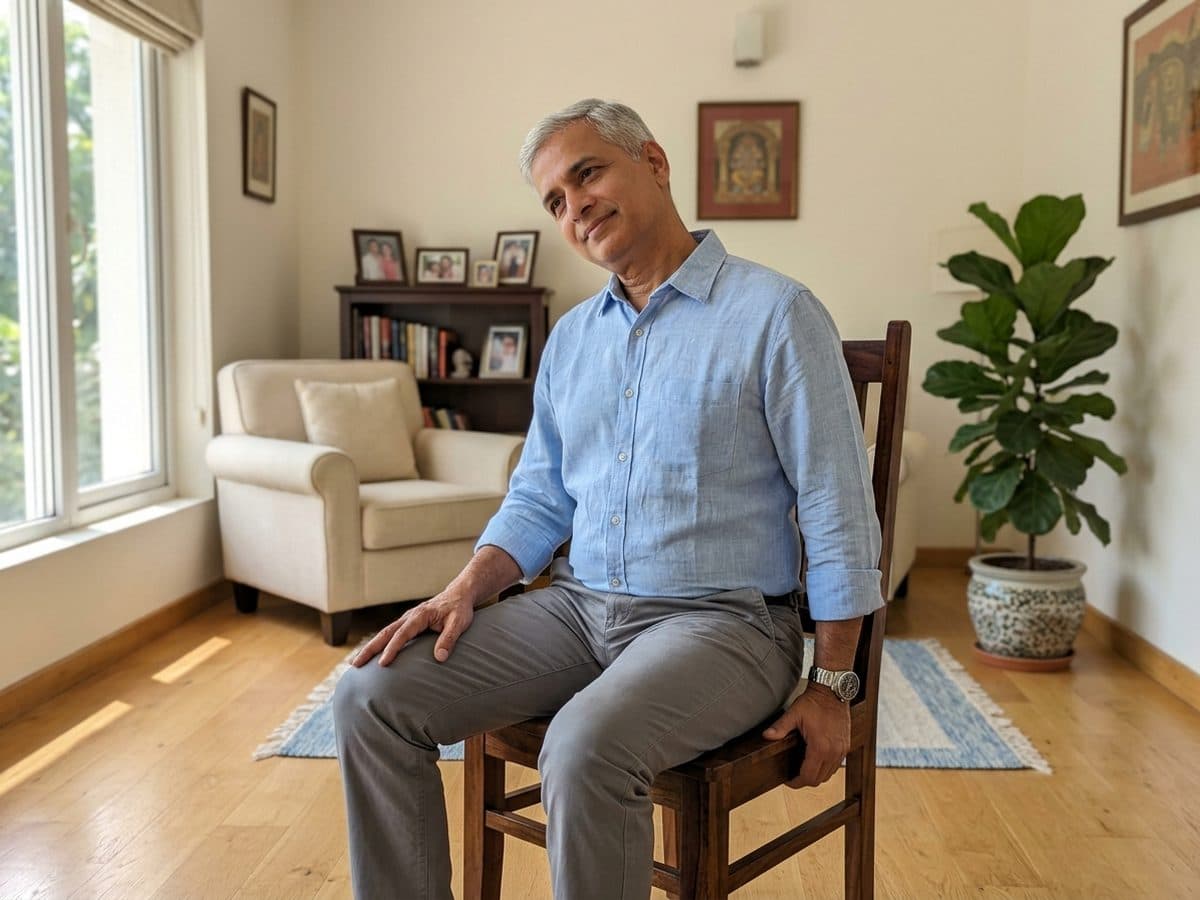
Stretches the muscles on the side of the neck that tighten from carrying bags and cradling a phone.
- Sit tall and hold the seat of the chair with the right hand to keep that shoulder down.
- Slowly tilt the left ear towards the left shoulder until you feel a gentle stretch on the right side of the neck.
- Hold 15 to 20 seconds, then return and repeat on the other side.
How much: 2 holds each side
Easier version: Tilt only slightly and hold for 10 seconds.
Stop if: Do not pull the head down with the hand. Let its own weight do the stretch.
Exercise 3
Neck rotation

Keeps the turning movement needed for checking traffic and talking to people beside you.
- Sit tall with the chin slightly tucked.
- Slowly turn the head to look over one shoulder as far as is comfortable.
- Hold 3 seconds, return to centre, then turn the other way.
How much: 8 turns each side
Easier version: Turn only halfway and keep the movement small.
Stop if: Move slowly. Stop immediately if you feel dizzy or your vision blurs, and tell your doctor.
Exercise 4
Upper trapezius stretch

Eases the tight, rope-like muscle between the neck and the shoulder that most people with cervical pain complain about.
- Sit tall and tuck the right hand under the right thigh to anchor the shoulder.
- Tilt the left ear towards the left shoulder and turn the chin slightly down towards the left armpit.
- Hold 20 seconds, then swap sides.
How much: 2 holds each side
Easier version: Skip the chin turn and do the simple side bend instead.
Stop if: A gentle pull is enough. Never bounce or force the head down.
Exercise 5
Scapular retraction
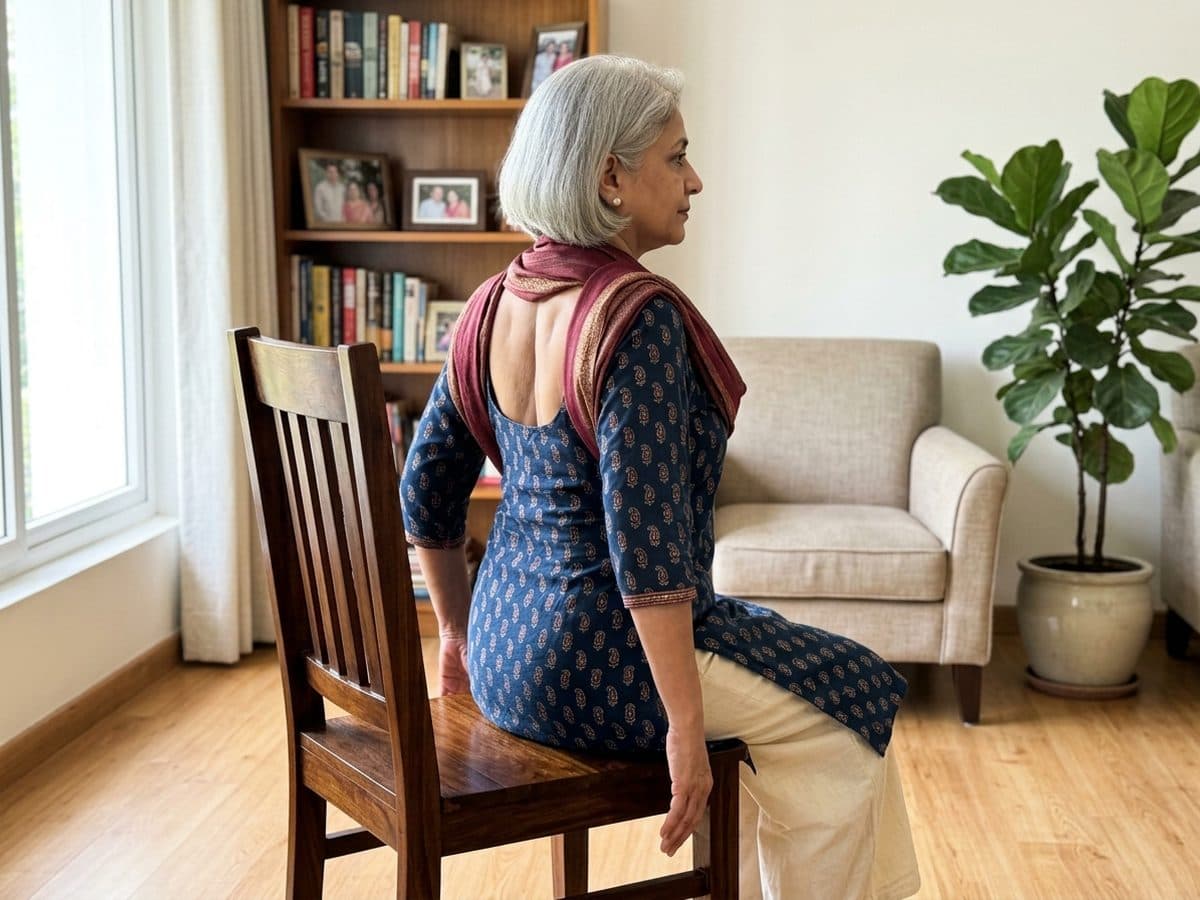
Strengthens the muscles between the shoulder blades that hold the shoulders back and take the load off the neck.
- Sit tall with arms relaxed at the sides.
- Squeeze the shoulder blades together and slightly down, as if pinching a pencil between them.
- Hold 5 seconds, then release.
How much: 10 repetitions, 2 rounds
Stop if: Do not shrug the shoulders up. The direction is back and down.
Exercise 6
Shoulder rolls

Loosens the shoulders and upper back that stiffen with the neck.
- Sit tall with arms hanging loosely.
- Lift both shoulders up towards the ears, roll them back, and let them drop.
- Repeat slowly, making the circle as large as is comfortable.
How much: 10 rolls backward, 5 forward
Stop if: Keep the head still and the chin tucked while the shoulders move.
Exercise 7
Isometric neck press

Strengthens the neck in all directions without any actual movement, so it is safe even when the neck is stiff.
- Sit tall and place the palm on the forehead. Press the head gently into the hand while the hand resists, so nothing moves. Hold 5 seconds.
- Repeat with the hand on the back of the head, pressing backward.
- Then with the hand on each side of the head, pressing sideways.
How much: 5 presses in each of the 4 directions
Easier version: Use two fingers instead of the whole palm to keep the pressure light.
Stop if: Use only light pressure, about a third of your strength. Breathe normally and do not clench the jaw.
Exercise 8
Thoracic extension over the chair back

Loosens the upper back so the neck does not have to make up for its stiffness.
- Sit on a chair with a backrest that reaches the middle of the back. Clasp the hands behind the head or cross them on the chest.
- Slowly lean back over the top of the backrest, opening the chest and looking slightly up.
- Hold 5 seconds, then sit up.
How much: 8 repetitions
Easier version: Place a rolled towel behind the upper back and simply sit tall against it for 30 seconds.
Stop if: Lean from the upper back, not the lower back. Keep the movement slow and stop if the neck pinches.
See a doctor before exercising if
- Numbness, tingling, or weakness in the arm, hand or fingers, or dropping things.
- Dizziness, blurred vision or fainting when you move or turn the neck.
- Neck pain that started after a fall, an accident or a sudden jerk.
- Difficulty walking, unsteadiness, or changes in bladder or bowel control.
- Severe headache with neck stiffness and fever, or pain that wakes you every night.
A 10-minute neck routine, once or twice a day1 min read
These are gentle enough to do daily. Many people find one round in the morning to loosen up and one in the evening after TV or phone time works best.
- Warm up: 10 slow shoulder rolls backward.
- Chin tucks: 1 round of 10.
- Neck rotation and side bends: 1 round each.
- Isometric presses: 5 in each direction.
- Scapular retraction and thoracic extension: 1 round each.
- Finish with the upper trapezius stretch on both sides.
Phone, TV and pillow: fixing the causes1 min read
Exercises help, but if the head spends hours a day pushed forward, the pain returns. Three habits cause most cervical pain in Indian homes over 50, and all three are easy to change.
- Phone: lift the phone to eye level instead of dropping the head. Rest the elbow on a table or cushion. Take a break every 20 minutes.
- TV: sit facing the screen, not turned to one side from a bed or sofa. The centre of the screen should be at eye level or slightly below.
- Pillow: it should fill the gap between the neck and the mattress and keep the head level with the spine. Two thick pillows push the head forward all night. Side sleepers need a slightly thicker pillow than back sleepers. Avoid sleeping on the stomach.
- Two-wheeler: a heavy helmet and a long ride tighten the neck. Do a few chin tucks and shoulder rolls after getting off.
- Reading and sewing: bring the work up to you on a cushion rather than bending the neck down to it.
What to avoid with cervical pain1 min read
Some common habits and exercises aggravate the neck joints. Leave these out until a physiotherapist clears you.
- Fast, full neck circles. They grind the small joints and can cause dizziness.
- Lifting heavy loads overhead, such as full water pots or luggage onto a rack.
- Cracking the neck by twisting it sharply, or letting someone else do it.
- Sleeping on the stomach with the head turned to one side.
- Any exercise that sends pain, tingling or numbness into the arm.
Doing these with a coach watching1 min read
Neck exercises go wrong quietly. People lift the chin instead of tucking it, pull the head down hard in the stretches, or shrug the shoulders up during scapular work. None of it hurts on the spot, but none of it helps either, and the pain stays.
Omfit's live classes put a certified coach on a Zoom call with a batch of nine parents, three times a week. Neck and shoulder mobility is built into every warm-up, the coach watches each parent's head and shoulder position on screen, and anyone with cervical spondylosis or arm symptoms is given the smaller-range versions before the first class, based on the health form the family fills in.
Live classes for parents 55+
Get this done live, three times a week
Omfit's coaches run these progressions on Zoom for batches of nine parents. Health history reviewed before day one, every movement corrected as it happens, updates sent to the family.
12 live sessions · batch of 9 · 7-day refund · no auto-debit
Common questions1 min read
Which exercise is best for cervical pain?+
The chin tuck. It strengthens the deep front neck muscles that hold the head over the spine, and it directly reverses the forward-head posture that causes most cervical pain. Do it several times a day, including after using the phone.
Can I exercise if I have cervical spondylosis?+
Yes. Cervical spondylosis is the wear and tear that shows on almost every X-ray after 50, and gentle movement and strengthening are the standard treatment. Keep the movements slow and small. If you get pain, tingling or weakness in the arm, stop and see your doctor before continuing.
Should I wear a cervical collar?+
Only if your doctor has prescribed one, and then only for the short period they advise. Wearing a collar for weeks weakens the neck muscles and makes the stiffness worse once it comes off.
Is a hard or soft pillow better for neck pain?+
Neither extreme. The right pillow keeps the head level with the spine when you lie on your side and supports the curve of the neck when you lie on your back. For most people that is one medium pillow, not two stacked. If you wake with a stiff neck, the pillow is the first thing to change.
How long does cervical pain take to improve with exercise?+
The stiffness usually eases within one to two weeks of daily gentle movement. The muscle strength that keeps the pain away takes 4 to 6 weeks of regular chin tucks and shoulder blade work. Fixing phone, TV and pillow habits makes the improvement last.